SLICE OF LIFE | Quinton Li
Debut novelist & chaotic curator of angel stories.
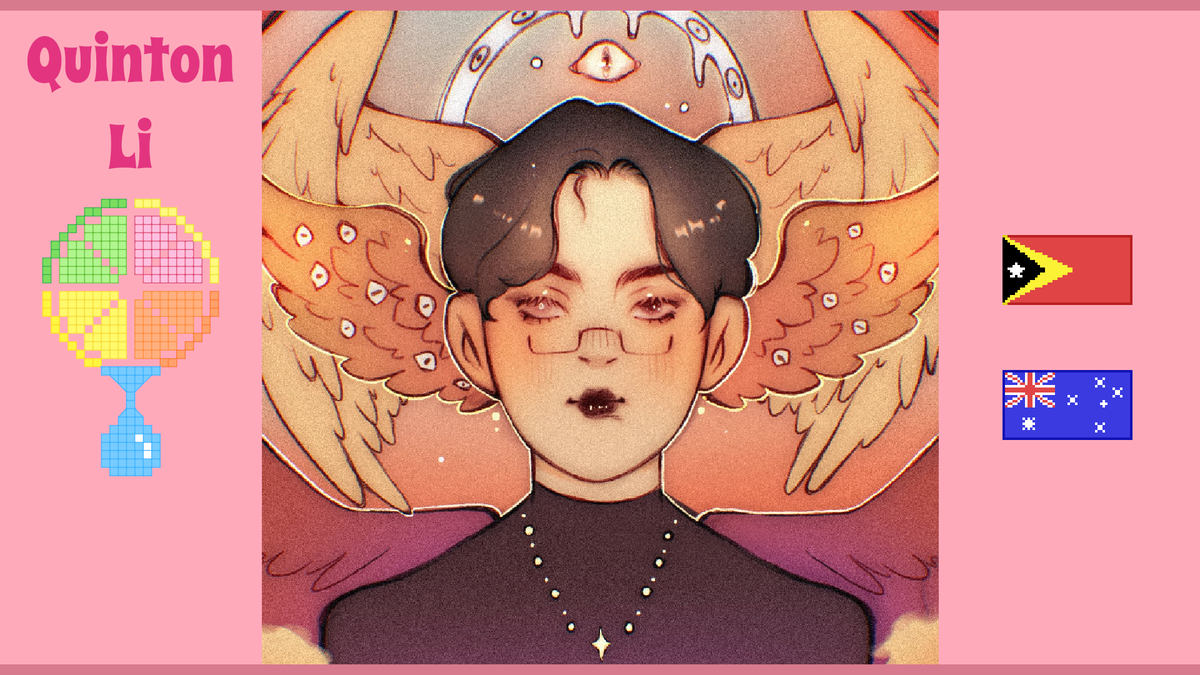
Quinton Li (pronouns: they/them) is a Timorese-Australian author and anthology curator. Their debut novel, “Tell Me How It Ends,” is a story that explores nuances in queer identities that become interwoven with fantasy and adventure. Recently, their love of all things angelic has led them to curate “DEVOUT,” an anthology about angels, where they also edited the stories that were part of the collection.
If you want a great conversation with them, just mention angels. Of any capacity. We mean it.
Viv: I’m super excited to talk to you, Quinton
you had one of the strongest responses to blood citrus and i was very thankful for that, since this is a very self-indulgent project
Quinton: Aww!
Viv: YEAH so to chat with other people who share similar backgrounds, especially those who I share a similar background with
(i’m a non-binary/greygender Southeast Asian creative)
is super cool! but ALSO
I took a look at your works and I was SUPER fascinated by everything that you’ve written, so that’s why I was like “I hope Quinton still says yes because I really want to talk to them.” LOL
Quinton: Aww, thanks!
Viv: I mean it, I’m such a huge fan.
Sorry i’m a bit skittish right now so I’ll try to shake it off.
Quinton: Oh that’s so flattering! and very exciting
I really wanted to do this with you, too, because so many people responded to your call for interest, so I thought “Oh my god, we’ll see how that goes.”
Worked out really well!
Viv: It does! It really does.
So first, I want to start with your publishing podcast, “Wide Eye.” I got through about half of the episodes, but it was still something I wanted to make a priority because I wanted to know what your experience was like with indie publishing and your process of going through it.
I’m currently on episode 5, where you talk about your debut novel, “Tell Me How It Ends.” What I really enjoy about listening to them is that it’s almost like I’m sitting in a call with you as you’re discussing the topics at hand.
Like you’ll talk about the finances behind your publishing or your social media marketing, and then at random you’ll do a google search or witness your cat walking across your keyboard.
Quirks like that are just so fun to listen to—like it’s very refreshing to hear you talk about your experience while also having those little fun moments that might not appear in traditional podcasts.
Quinton: Aww that feedback is really great! I definitely wanted that kind of feel, or at least try to, because i know podcasts could be hard for a lot of people to listen to. I thought to myself, “if it’s a bit conversational and a bit how i am with personality, then it will come across a bit easier, so i’m really glad to hear that.
Viv: It really does make me feel like I’m sitting in the room with you as opposed to you just talking in a separate room. I often think that with podcasting, it’s a bunch of people in a room talking and you’re just kinda listening in. but with “Wide Eye,” it sounded a lot like i was in the room with you or that you were doing a speaking session. It almost had like…
i don’t know if you’ve ever had this experience before, but like it’s when you’re in a Zoom call in a business meeting, and someone’s cat walks across the keyboard and you see their cat walking across
Quinton: Yeah! Hahaha
Viv: Haha yeah it gave me that exact feeling! and it made me feel a lot more at home, just sitting and listening.
Quinn: That’s so funny, yeah
Viv: It is!
So in terms of the actual concepts that you talk about within “Wide Eye,” you mentioned topics like your finances, so you talked about the costs of publishing, social marketing, your assets, editors, etc, as well as your overall decision to indie publish.
I’m really curious to know what it is about “Wide Eye” that made you want to create it, and what the process was behind planning out the episodes and establishing the concept itself.
Quinton: Yeah alright, I can go into that!
So I feel like everyone in the world, at least once, thinks about starting a podcast. In my case, it was thought that I had in the back of my mind which was “I want to start a podcast someday.”
It’s a big step from where I was years ago, because I didn't use my voice a lot online. I was usually the one who was muted sitting in a call and just listening. Now i’ve grown more confident speaking, so i suppose i like to take projects that encapsulate this new development or different things I do. It’s not only my podcast, but across my publishing as well and different projects I do.
I guess the core of the “Wide Eye” publishing podcast is that in publishing, it has a lot of consensus thinking or people approaching topics with that mindset. when someone gives publishing advice on the internet, they think that is the top advice and objective advice that everyone should follow. I feel like that’s not how advice should work, or at least that’s not how we should support each other in the community. Things like individual experiences will help much more than people trying to teach others the best method that they think is going to work.
So taking my desire to do a podcast someday and my experience in the actual publishing industry (at least online), I wanted to create a podcast where the selling point was that it was my experience and what I’ve been through and my perspective on things.
With my podcast, I know that I don’t have to be an educated expert with 20 years of experience. I could just be someone who’s actually experiencing the industry while working on different projects and just telling people about it. Like we established, I wanted to be conversational in a way where it’s as if someone asked me a question in DMs and then I answer them, except it’s in a podcast form. I wanted it to be accessible, not just to one person who asks, but whoever may come across these questions and want to know about them.
Really, it’s about accessibility of information and also trying to lead by example in that advice doesn’t have to be the top-end one-say-fits-all.
Moreso that sharing our experiences is important and can bring perspective to other creatives.
Viv: This is super reassuring to hear as someone who’s been exploring a lot in their creative journey, especially with different creative mediums. What I enjoy about storytelling is exactly what you’re saying—I think it’s very powerful to have a collective group of people share their experiences and have that be like a…buffet of advice if you will LOL
In the sense that people can take pieces of advice that can apply to them, and leave the pieces that don’t. There’s no need to take the top-end advice and you don’t have to apply that directly to your experience since everyone’s different. So I'm glad that this is some of the motivation behind creating “Wide Eye.”
In one of the episodes, I think you mentioned that when it comes to publishing, there are some stories that just don’t make it through the filter of what is considered “good enough to publish.”
Quinton: Mhm
Viv: And the issue with that is, you can’t really have the conversation of what is considered good or bad to publish if there aren’t a lot of options to begin with. Obviously, one of the solutions is to have more experiences in the pool.
Your response has given me reassurance that what I’m thinking isn’t entirely out of the ballpark. We all share the same idea that we should all be sharing our experiences. I also love what you said earlier that people who give advice don’t have to be “super experts.” If you have the experience, that’s your basis for your advice.
Speaking of sharing your own stories, I’d like to dive into your debut novel, “Tell Me How It Ends.”
You don’t have to tell me how it ends (hehe)
Quinton: hahaha!
Viv: But I would love to give you the space to talk about it. I remember when I read the blurb and the first thing I thought was “I swear to god, I think you wrote this story for me.”
Quinton: Aww!
Viv: I love tarot, but I also love seeing aro/ace representation (as an asexual + greyromantic). We don’t really get a lot, if any, stories that involve relationships surrounding that.
So I’d love to hear about the thought behind the story, your process, and everything you’d like to talk about with “Tell Me How It Ends.”
Quinton: Okay! I’m very happy to talk about it, and I’m very glad that you resonate with some of the aspects of it. I am very proud to have written and published the book and for people to read it, especially if they do relate to some of the identities that the main characters are all about.
I think it really goes back to how writers are outside of publishing, which is lots of different projects and giving it a shot and seeing where things land. For me, I had initially begun with a bigger project that was a bit more of what you’d see as like, mainstream fantasy
or i suppose like…medieval fantasy that you’d see from years ago, and that comes from influence of what you read and what you consume.
But then i started “Tell Me How It Ends” because it was kinda my side project that I used to take a break from my main project
Viv: relatable haha
Quinton: haha yeah, my main project was full of all these different plotlines and all these characters and i tried to stuff a lot in. That’s what happens when you’re a young writer as well.
I wanted to write something a bit more…calm, in a way. And a bit more lowkey that i wouldn’t have to do so much thinking to write it. During that time, I had recently gotten into tarot cards (this was like years ago), and i wanted to write a character who used tarot cards, but also wasn’t a super OP character.
the reason is because tarot cards, lots of people use it as or conflate it with fortune telling. It doesn’t necessarily have to mean fortune telling—it can just be like guidance or just a way to understand your feelings more.
Viv: Ooo, yeah!
Quinton: so about my character, Iris Galacia. Iris is a lesbian tarot reader who also has autism and anxiety. She doesn’t know everything that’s about to happen—if anything, she’s thrust into this adventure that she would never have thought would happen, because of another character who is a bit more chaotic and eccentric, Marin, who is our aro-ace enby. I thought it was a fun exploration to see what kind of adventures could someone go on if they had this ability, and yet life still throws curveballs at them. It’s very reflective of my own philosophy around thinking about the future as well.
I, alongside other people, very much think “what’s going to happen?” and try to picture ourselves in that future to try to predict things, whereas sometimes that only stifles our options and opportunities, and then we get upset at that. But if we kinda embrace the change more, and don’t rely on the cards as much to tell us what’s going to happen or what to do, then we’re able to be more open to our interpretations. So it’s a bit of a parallel metaphor in certain ways with how tarot works and how the future can work, as well as just some fun queer characters on an adventure, going out and doing cool things. It still has semblances of that epic fantasy story where it is still a medieval-ish adventure with castles and armored knights and guards and taverns and going on a ship with pirates and all that, but it also has that nice twist of characters who are like us in these cool adventures.
They don’t necessarily need to save the world—or at least in this book they don’t have to save the world (laughs), and it can still be an enjoyable fantasy read.
Viv: As someone who has done tarot before, I agree with you in that that there is this public consensus of tarot being associated with fortune telling or predicting the future. And while it does seem like it has similar elements to fortune telling, they aren’t the same, and you’ve said it beautifully. It’s more of a conscious guidance to help with understanding where you are and where you want to go. So I feel like that’s the definer in what differentiates tarot from fortune telling.
But also, I just really like seeing queer characters who are similar to me go on cool adventures. There are people out there who love RPGs and roleplaying and they want to explore fantasy realms, and sometimes I think inserting ourselves in these fantasy worlds can help us discover ourselves in ways that the real world doesn’t.
Quinton: No I agree! Because by writing my characters, I actually found out more about my own identity, especially as a neurodivergent person as well. It can be difficult to see yourself in fiction these days, especially cause traditional publishing is quite slow in integrating the diversity of people and readers. So being a writer, writing the characters that I do get to share with others which is really great. I still find out more about myself, which is even better.
Viv: That’s exactly how I feel with my stories too.
It’s definitely not a replacement for proper therapy, but it’s a playground to let me explore my identities and figure out how to put my thoughts and feelings into words.
Damn, now I’m excited to get my own copy of “Tell Me How It Ends.” I think I’ll buy it along with some other books I want to read from my friends who are also Southeast Asian authors. I wish I could express to you how much I want to read it because like
I’m excited at the thought of seeing someone who’s like me in a book LOL
Quinton: That’s so awesome! I’m excited for your friends as well.
Viv: Yeah! I want to support however I can. Even just giving you this space to talk about your book, I want to do what I can to show you that your work matters, especially when we’re faced with a lot of obstacles in traditional publishing.
I think there’s a long way to go before people who are behind the reigns of traditional publishing understand that there are a lot more voices and more walks of life than just what’s been portrayed in mainstream media.
Quinton: Yeah, exactly.
Viv: It’s gonna be a while.
But also, on top of your podcast and your debut novel, you also curate anthologies. Your most recent one, DEVOUT, is interesting to me because it touches on angels. You’ve expressed interest in angels specifically on social media, so I’m curious to know…
…how the heck did you get into being a curator for anthologies, and what made you decide to go with angels as a topic for this one in particular?
Quinton: That’s a really great question, and something I’d love to talk about!
So the current anthology I’m working on is called “DEVOUT,” an anthology of angels. It’s actually the first anthology I’m working on, even if other people may not think so, in which, if they do, I’m very flattered.
Viv: yeah that’s what I thought! I was under the impression that you were a veteran curator for sure, so to hear this is your first anthology is so impressive.
Quinton: That makes me really happy to hear, because it is something I do want to continue doing and even want to move it from a hobby or side project to more of what I want to do with my career and that path. But i suppose, in a very similar sense to podcasts (but not to the same extent), i don’t think everyone wants to do an anthology because it’s a more niche thing. But for me, i knew that i wanted to do anthology work at least once someday, because i wanted to have that experience of working with others while not necessarily having to write the content, in a sense.
When you publish a book, you’re publishing your full work. Whereas for an anthology, there’s much more of a community aspect to it.
I guess there’s a few questions here to answer. The first one I kinda went over which is, i’ve always wanted to do an anthology and do that work. There’s opportunity to meet other writers, to experience different types of writing. also, i don’t know how to describe it in a more sophisticated way, but for me…i can say you can bring happiness to a lot of people in putting yourself and the authors and the audience out there. So i think this can be categorised as, apart from curating, arts administration or arts management, which I really want to get more into and gain more experience in. that’s all about connecting the arts, the artists, and audiences, which is basically the core of what this task is. I could say job, but i suppose task is the better way to say it as well.
in terms of the specific anthology, i’m part of this small community where we’re all on Discord and we all came together because we all have an interest in angels. There’s about 14 of us, I believe. It literally just started as a group of friends chatting about random stuff, not even just angels, and we also write.
It’s one of those things where you throw around a joke in the group like “Oh I’ll do an anthology one day, we should do that, we can do this cool project together.” but no one really actions it—not for any bad reason, but just because it’s meant to be all fun and games. But I thought “you know, i want to do this project and i think i can make the time for it. I love all these people here, and we all like angels.”
For me, angels…i wouldn’t say it’s personal in a sense where it’s like I wouldn’t share it (of course because i’m doing this anthology in the first place), but in a way where angels as a concept means a lot to me because i love what they represent, the different designs for them, different mythologies you can find them in. it’s kinda the vibe that you click with.
Some people click with certain things, For me, it’s angels. I thought, “Maybe this is the perfect opportunity to take this up,” none of us could have expected where we’re at now, because this all started at the start of 2023 i believe, where i began brewing up the idea of it.
We have our ARC readers, and it’s such a cool experience because a lot of the authors are telling me that they wouldn’t have expected it to be this experience where they have people reading their work and enjoying it. And I feel super fulfilled through this task. I feel like i’ve found out more about myself and i’ve learned a lot of skills and it just…in a way comes naturally as well.
Like there are challenges to learning things, there’s always going to be a learning curve to things that you are pursuing. While i’ve published a book, it’s not necessarily the same as publishing an anthology because it involves more people skills, more organisation skills, you need to be in charge of the timeline, you need to be the decision maker, etc
Of course there are anthologies out there where there may be more executive people who make decisions, but at least for this one i wanted to take the lead and it made sense for me to take the lead in this situation because i have decided to take up the project out of the little thing we threw around in the group about making the anthology, so it’s been a really great experience being a curator and being able to read all the works. I added suggested edits for all of the authors so that they could get back to me about their thoughts on it.
I get to work with Alex, who is a designer who designed the cover of “Tell Me How It Ends” actually, Alex Patrascu, who’s also working on the cover for “Devout” and the interior formatting. You get to work with all these different creatives and put their work together in a collection that ideally makes sense.
People have told me that they like the transition between certain pieces and i’m like “yes, that is what i intended,” but also I guess surprises of people pointing things out that i didn’t exactly intend to do, which is still super cool.
Like I mentioned earlier, I definitely know that i will continue this path of curating anthologies and connecting authors together, and hopefully as i said, bringing more happiness to other people and bringing these opportunities because sometimes it’s all about the opportunity.
And to mention it in another way, accessibility is important to me. The only reason why some people don’t get these opportunities is because they don’t find them or they don’t know about them or because they feel like they can’t do it, but that’s why everyone thinks at the start, and their mind can change for the experience as well.
Viv: I do want to go into the accessibility portion in a later bit, because I think that accessibility is very important and goes beyond things like closed captions on a film. It does also include considerations like “how do we get these types of materials, these media, in the hands of people who really enjoy it?”
But before we get into that, I’m noticing a pattern in your line of work, and it’s that you are all about collaborative efforts and community. Taking your anthology “DEVOUT”, for example, anthologies are about collecting works from other creatives and putting it into one cohesive piece. With “Wide Eye,” you talk about your experiences with your publishing in a way that is presented as a collective of your thoughts that you’ve gotten from your experience. And then with “Tell Me How It Ends,” obviously there’s a collaborative aspect behind that where you have to have someone who does the art, who does the editing, who does the publishing
Well…it’s indie publishing
So in all of your works, community and collaboration are two things that seem vital to your creative process.
Quinton: Yeah, you got it exactly right, and I always get really happy when people…get that impression I guess haha
Viv: hahaha!
Quinton: Cause I want to be someone who people can trust for advice, and i’ve been very fortunate that some people have.
Like people will message me saying “I know that you did this and I’ve noticed that you’ve done this, i’d like to know more about it” and I’m very happy to talk about cause
i know that a lot of people may still feel like they need to keep it to themselves, which is not something i will fault others for—some people prefer privacy, which I completely understand. But for me, it’s important that those who do feel comfortable with it can share with others because in a way, we’re all in this together. It’s kinda cliche, but everyone’s here on earth to do what they want (ideally), and we can help each other do what we want in a way haha
It’s all very important to me, because as a person who is underrepresented in a few aspects, from my cultural identity to my gender to my neurodivergence, that sometimes means that we can be barred from opportunities or knowledge because of this. Or even because of age, since I’m a young person as well.
I believe that every one of us who makes a step to share this information is already a strong thing that resonates with me, and that’s why I’m here. It aligns well with my values on people being able to access experiences and knowledge that will help them along as well. I don’t think i can imagine being isolated in this experience where I only focused on my own thing.
I do find merit in that like...i believe for example, the writing process, i don’t need to publicise every single thing i’m writing in every moment. I can publicise it later on in the process when i’m ready to, so there are parts where i hold boundaries of what i want to work on individually and what i want to do collaboratively.
When i think about what i want to do with my time and what i find myself happy to do and fulfilled with, it’s being surrounded by other people like me who wants to do good and who also want to give to others in the world because we deserve it. Things are about give and take, and sometimes that can be seen in a bad way, but i think it’s a good thing too.
years ago, i wouldn’t have been in this position, and while i didn’t have solid or exact mentors or programs that I was a part of that i could extracurricularly, i know that by being exposed to other creators who are proud to do what they do, that has led me to do the same thing for others.
Not only do I give out other things, but i still consume other things. I consume stories of others and i want to learn more about them, so it’s always a learning journey as well, as well as being able to teach in different ways, cause teaching can come from doing anthologies or it can be publishing a book or a podcast or talking here, so yeah!
Viv: I know the feeling all too well about the idea that we have to silo ourselves and be able to do a bunch of things at once as one person, which is why i was so happy to learn later down the line that there’s actually a lot of benefit that comes from working with other people.
You nailed the point really well in that as you work with more people and as you bring them together and build a community, it becomes more accessible naturally as time goes because you have these nuanced perspectives. You bring in new and fresh perspectives that can colour the experience of someone who is just joining a community or just trying to get their foot into the industry.
So when it comes to indie publishing, for example, if I see you, a neurodivergent, non-binary, Timorese person, I’m like, “wow, there’s a lot of intersectionality that I can relate to. There’s a chance that people like me will see at least one of your identities and be like “that person resonates with me, and i’m glad that they’re doing this, because if they can do it, then i can too.”
And it becomes this chain effect of people who are similar to you or have crossed the same paths as you being able to pursue similar career paths. And then naturally, many opportunities become accessible and people become a lot more open-minded, because now there are more identities to connect with and relate to.
I’m glad you brought that up, because it’s so reassuring to know that people like me and people who are similar to you and me don’t feel alone. It’s a very comforting feeling, especially when there isn’t much representation and you don’t see much of yourself in other stories, so that does mean a lot. I don’t know how else to word it, but just everything that you’re saying means a lot. It really does.
Quinton: I think you worded it completely well, and I was really happy when you said the example of seeing someone else who has the same or similar intersections and thinking “I can do it, too”—it’s very heartwarming, and i think we need more of that, so i’m really happy about that.
Viv: I’m glad to hear that!
Also, this is a bit of a tangent, I think you’re the first Timorese that I’m interviewing for this project!
Quinton: Haha yes! I feel special.
Viv: Hahaha
I’m glad this project connected you and me together, because I don’t think we would have interacted otherwise. We wouldn’t have this convo on the map.
When people think of Southeast Asian countries, I think East Timor is one that very rarely gets brought up, so it’s awesome that we’re able to have someone like you as part of this feature series.
Quinton: Haha thank you!
Viv: Of course!
Let’s go back to the accessibility topic, because I can tell that it’s important for both you and me. Accessibility in general is important, but it’s also important to note the different avenues of how people can define “accessibility.” I wanna go into that, especially since your novel “Tell Me How It Ends” covers a lot of topics surrounding disability and neurodivergence. I’d like to know how you interweaved accessibility in the storytelling internally.
Quinton: Okay, I can work with that!
I think one of the first things i thought of was around gender accessibility. One of the things in the story is that people use…pronouns haha
I mean everyone uses pronouns, but it’s normal for them to say their pronouns upon introduction. They don’t do it at the very start, if not like upfront, but it seems very naturally weaved in.
So for example, later in the book, within the first half, when the characters are introducing each other, there’s a group and there’s Iris and Marin as the main characters, they say their pronouns or what their pronouns are with their name. They may not necessarily say pronouns itself, they may not say like “they/he,” but a character later in the book says “I use masculine pronouns,” so they may say it in different ways.
And i think that in a sense is accessibility of information. i’ve heard a lot of readers who told me that they learned about characters who used neutral pronouns or they/them pronouns in the story, or they learned about how this custom may work.
If you were to introduce yourself with pronouns, you don’t necessarily need to ask what they are, you can just say, using me as an example, “My name is Quinton, I use they/them pronouns.” Or a main character of someone else could say a similar thing.
I suppose in another sense with disability but in a less physical disability sense, my main character has autism and Marin has ADHD. In this case, labels aren’t used upfront because there wasn’t really an opportunity to use them, but it is very implied in the way that these characters think and talk, and it’s also shown in the narration voice. I’ve heard quite a few people who have told me that Iris, in the way that she thinks and speaks and reacts to situations, really resonates with them. So in that sense, it doesn’t put a barrier between a reader and the character. You can still enjoy the character even if you don’t share the same experiences as them, but it can connect and click very well for people who do have them.
I did think of another thing to jump back to, which is Marin being aroace. that is one of the key identities that are mentioned in the book, where they do mention the labels themselves. I don’t remember which order it was—they either said they’re aromantic and somewhere on the aspectum, or they said that they’re asexual and they’re somewhere on the arospectrum…i don’t quite remember, but it’s one of those combinations haha
So being able to show that is a form of accessibility as well because it’s revealing information in a more transparent sense to help people understand the character.
The final one i can talk about is that there is a character who is deaf and mute. She is the captain of a ship, and—
Viv: YOU PUT A PIRATE IN THIS STORY???
THAT’S SO COOL
Okay sorry, go on LOL
Quinton: haha, that’s alright!
They’re technically genderfluid, though i believe I stick to one set of pronouns just to keep it easy to keep track of throughout the book. But she is deaf and mute, so she uses sign language, and it doesn’t have to be in-depth. I’m not a sign language user, so I don’t know the exact movements, but I do describe that there are hand movements and touches to the face and different ways that sign language may work, which can be a mix of my exposure to Australian Sign Language or Auslan, vs. ASL or American SIgn Language.
There’s no specification, but it is noted that they do use sign language along with their first mate, who is implied to be very close to this captain. they both converse in sign language or the first mate may translate things in sign language during conversations between the captain and other characters. In that way, even for Iris, she kinda represents someone who may not have that exposure. she notes that she has never seen someone use sign language before, because in her very sheltered life (or in what she had in a sheltered life) she didn’t really have exposure to these things, and so herself as a character is kinda showing that accessibility in understanding other people in a very naturally way.
it’s not loud in a way, it’s not celebrated in a patronising way to say like “oh my god look I wrote this form of accessibility into the story where characters are using sign language to converse.” it’s really just…characters are doing it because that’s their thing and Iris is like “huh, that’s new.”
the way i see it, my type of representation can just be…smooth, in a way haha
It’s kinda just integrated into the story. I hope that answers the question because I went with points that I thought would relate to what you asked.
Viv: Oh yeah you answered it wonderfully! And what i really love is that when I’m looking for different media to consume, I’m a huge fan of media that just…is haha.
Like that’s just how the characters are and who they are. It’s not necessarily something that’s sensationalized or something that’s done for the sake of being able to hold the label of “diverse.” that’s the key to diversity for me. The experiences we create are just…that’s who the characters are and it’s a very normal thing, not just something that’s something meant to be put on a pedestal.
Not to say we shouldn’t praise people for actively trying to incorporate diverse voices into media, but it’s more just so that there’s a process of trying to replicate diversity in media that isn’t just watching other people do stuff, there’s an art form to doing it.
The way you discussed Iris and her mannerisms—anyone who is autistic might be able to pick up on that, even if you don’t explicitly say that Iris is autistic. In the case of Marin, who is aroace, delivering that information explicitly as them being aroace could help or inform people like me and confirm my theories about them being aroace. In my head I would think “okay, what I'm thinking is correct.” I’m not having to speculate anything.
I don’t want to act like your work is the end-all be-all of representation, but to have another book that explores those identities is refreshing and I think it’s a good example of one style to show representation in media.
So yes, you did answer my question beautifully, and I enjoyed hearing about the characters in your book.
Quinton: That's awesome! I’m glad I answered that, then.
Viv: You did! Very well, I might add.
Now we’re on to the final section of this interview: Choose Your Own Question! Which one did you want to go for?
Quinton: Hmm…
I do like food, so I think I want to go with Food for the Soul.
Viv: Okay wonderful! Let’s dive into your favourite food or drink!
Quinton: Yeah!
So there’s a place here called Nando’s. I’m not sure if you have it over there.
Viv: I think we do, but it’s only in select regions in the US. I’m not sure I’ve heard of it.
Quinton: Oh I see! I’ll need to confirm, but I think it’s a Portuguese and South African cuisine, which is…not relevant to my cultural background haha
but it’s still one of my favourite spots. I had it yesterday, so I’m like, “Might as well talk about it now.”
Viv: Haha that’s fair!
Quinton: For me, it was a strong introduction to foods that I previously didn’t like, but now do like.
one of those foods for me is salads. I used to be very bad with salads and vegetables, because that’s what kids do when they’re little: they don’t like it. So when they grow up, they don’t like it again.
But I went to Nando’s, and I don’t know why I had it, but I ordered the salad, and it was just the best salad I’ve ever had. It’s always consistent at every store you go to every time you order it. It tastes really fresh—they just do something so well with it.
It’s got lettuce, tomato, cucumber, avocado, feta cheese, quinoa, and sweet potatoes. So it’s like a normal salad, but it tastes like…really good haha
And that’s only one of the things I order. I usually also order paella, and that usually comes with a seafood variation, but i’m not so much of a seafood person. this one comes with chicken and capsicum and a nice spicy saffron rice, and it’s just so good. I don’t really eat paella otherwise.
With salad, i eat more widely now, but I really love Nando’s salad the most. This food is so good, and I think this also can relate to some cultural sense where i think sometimes we can have preconceptions about certain dishes or even on the other side, not know enough about the dishes that different cultures have.
For example, you mentioned before that with Vietnamese food, most people think about soup. But there’s also all these other dishes as well, with different meats and vegetables and different rice dishes as well that are great. Also, the Vietnamese drink selection is really awesome.
Oh excuse me, one second.
Viv: yeah, no problem!
[a few seconds later]
Quinton: My cat was meowing outside, so my brother let the cat in.
Viv: Hahaha all good!
Quinton: Anyway!
So as I was saying, there are preconceptions about certain dishes and what dishes are associated with different cultures. For me, I wouldn’t really know about Portuguese or South African food at all. But because I go to Nando’s, it’s not like I’m suddenly an expert, but I have more exposure to it. Previously I’m just neutral, but now I’m very positive about it cause i’m like “this food is great, they know how to use their spices, and they make really good salads.” haha
So I think the same can be said with other things. For example, with my own background as a Timorese person, it can be difficult to pinpoint what dishes are actually associated with my culture, because there’s a lot of crossover between Chinese food and Indonesian food, so it can be hard to know what is TImorese food.
But there are some really good dishes out there. Last Christmas, my mum made a bunch of Timorese dishes. There was like, this sweet and sour stewed pork, and then there was this chorizo and egg mix you can eat with rice.
Timorese cuisine has these really nice meatballs that I really like. They’re not the same as European meatballs or soup meatballs, they’re fried—and they’re really good. They’re like my all-time favourite, so I’m glad my mum can make them haha
I guess this did lead to my cultural identity because I did manage to think of something that connected. That’s my opinion on discovering foods from different cultures and conceptions around them. And that i discovered that I like certain foods because I tried them at a certain restaurant, and now i like it.
Viv: WHOA OKAY SO, first off
I’ve only known Nando’s as a chicken spot. I’ve never had it, but that’s the first thing I had heard about it. So when you said salad I was like, “Oh wait…chicken…in the salad?”
And you’re saying it’s really good so I’m like “okay, well if you’re someone like me who also didn’t like salads growing up and you said it’s really good, I might have to find a Nando’s nearby to try it.”
Quinton: You can have chicken with it! So that’s good. I add bacon to mine because I like it when bacon’s in a salad haha
Viv: *GASP*
THAT SOUNDS GOOD
That’s the key to good salads—we need to stop having people just put vegetables in a bowl and call it a day. You have to add some stuff to it to make people eat it.
Quinton: yes, exactly.
Viv: damn…now I REALLY want some Nando’s
But more importantly, I love what you said about how it exposes you to different cultures and learn more about your preferences. Especially in the context of food, it’s just like “I used to not like it, and now I do.” or “I don’t know if I like this, but now I know I really do.” and that’s super important.
Like if a dish is made one way, and it’s not to your liking, there’s maybe five other ways that ARE to your liking.
I’m glad you brought that up. Because again, I’ve never had Nando’s…and now I really want to haha
Quinton: Oh that’s great! I introduced one of my friends to it yesterday, actually. He knew nothing about it, he just works nearby one
And now he’s like “I’m gonna come back” cause he really likes it haha
So i’m just here introducing the Nando’s agenda.
Viv: You must
I don’t eat fast food often to begin with, but this one sounds like a new experience I have to try.
I also heard that it’s known for having a good spice level as well.
Quinton: I think that’s pretty right, except that I don’t have spicy food a lot haha
Which I probably should because I’m Asian and we have spices. But they have peri-peri sauce that can get really hot, so that would be correct.
Viv: Alright so whenever I do get Nando’s, I’ll try it out and report back to you hahaha
I’m so glad you also mentioned Timorese food, because I’ve never heard of its cuisine.
But it’s so cool to hear its influences.
In the same way that Vietnamese food also has influences from different countries and regions.
Side note but I just googled “Timorese Meatballs” and they look GOOD. I’m gonna see if I can find a recipe for them and try them.
Quinton: Yes
As you should
Viv: Haha!
Okay, we’re gonna wrap this up, but are there any last minute things you’d like to say?
Quinton: Yeah! I think very in line with what we’ve been discussing anyway is don’t be afraid to be you—not just personality-wise, but all aspects of yourself. whether it’s your cultural background, and for me as well, as someone who was born in Australia, it can be hard to feel connected, but there are ways to feel connected by meeting other people and talking to your family or for example like food, music, dance, events, these things can help connect.
And also for me, as a non-binary, queer, and neurodivergent person, it’s okay to be those things and to be proud of that. On the other side of that, if you feel like you are a bit nervous to do that or you don’t know where to start, then you should seek out other people that you admire or other people that are a bit more open with these things and willing to share
Because as we’ve discussed, if you see someone or talk to someone who has those experiences and has been through things and can tell you about it, it will make you more likely to feel okay with being that way too or thinking that you can do it as well.
Basically, if you’re able to and you feel happy to do it, be proud of who you are and show it off. be open to others and be kind and compassionate and curious. And on the other side of things, if you’re not up to that part yet, then seek out others who are willing to share information and spend time and give them wisdom I guess haha
That way, you can feel a bit more comfortable. It’s very understandable for people to not feel comfortable as well, and at the same time, people like to have their privacy as i said, in the online world especially, you don’t have to share everything about yourself, so that’s a good option too. That’s my final note.
Viv: those are solid pieces of advice, I know that I’m going to apply your words to myself and my creative endeavours.
Thank you for sharing—and good luck on publishing DEVOUT!
Quinton: thanks!
FOLLOW QUINTON ON SOCIAL MEDIA
Instagram: https://instagram.com/quintonlieditorial
Twitter: https://www.twitter.com/itsquinnli