SLICE OF LIFE 2 | Samantha Chong
She loves fiction, food, and fun puns! Cue exclamation points!!
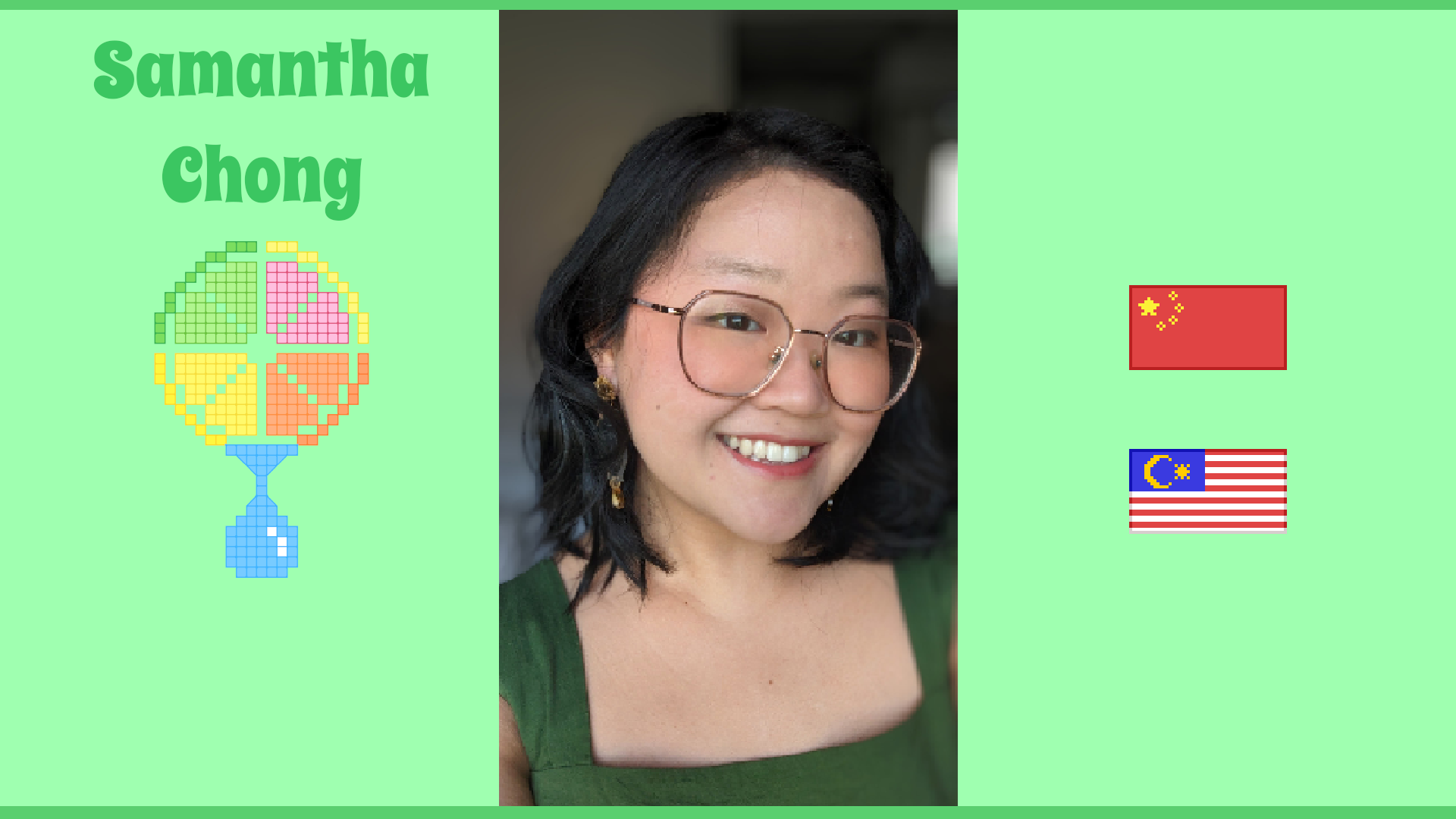
Samantha Chong (pronouns: she/her) is a Chinese-Malaysian writer, filmmaker, and photographer with a knack for wonderful puns and scrumptious food. Her storytelling journey has led her down a beautiful(ly chaotic) path into publishing, resulting in her writing her debut novel, ‘PRODIGAL TIGER,’ coming Fall 2025. When she’s not splicing words and adding (yet more) character lore into her stories, you can find her cooking, taking photos, or publishing her next newsletter.
Considering that I also love food, puns, and great storytelling, you could say that our chat started off REALLY well:
Viv: I love that you love food and puns
So when you responded [to be part of this series], I was like “OH THANK GOODNESS”
“I LOVE THIS PERSON”
“AHHHHH”
Sam: Well that means so much hahaha
I do love all those things (to possibly a detrimental extent)
BUT I DO LOVE ALL THOSE THINGS
Me: You and me both
Sam: BEST FRIENDS FOREVER!
We truly are. In fact, don’t be surprised if you see the two of us sitting at a restaurant taking photos of our three-tiered seafood platter for 10 minutes because the sun is out at just the right angle. Can you blame us?
Okay, food fantasies aside, I wanted to know exactly how Sam got into storytelling and what inspired her to invest in writing.
And dang, did I get a GOOD answer:
Sam: So a lot of it was…it was kind of organic
I think as a kid, I loved reading a lot, so it was one of those things where I was like, “it’d be really cool to write.”
The closest novel-length thing I ever really completed was a bad X-Men rip-off hahaha
Viv: HAHAHAHAHA
Sam: I actually found it a couple of months ago and I looked through it and I was like
“...Oh boy” LOL
It’s a first start, it’s fine hahaha
I love the idea that you could build these fictional worlds.
So like growing up, especially in secondary school when I would be talking to my friends, we would write these little stories and pass them around the class (like in between classes and stuff)
I went to college and did a lot of spoken word there, and that was interesting too because spoken word and poetry in general is just such a different way of telling a story, and I think that really helped me think about different storytelling [methods] and different forms and different narrative media
I started writing this draft [for Prodigal Tiger] in 2019 and I was like “This will be a short story!”
…It was NOT a short story LOL
It was almost 600 pages (double-spaced) by the time I was done with it hahaha
And then about halfway through, i was like, “Oh i should really think about actually trying to do this” and like, go back to that childhood dream.
So that’s kinda all how it came about
and now i’m in the publishing journey, i guess LOL
Viv: you’re making it to the big leagues of getting your story out there
Sam: Yeah
Uhm, hopefully
I’ve got the bat. Someone throw me the ball! I’ve got the bat!
Hahaha
Viv: You’re standing in the baseball field, you’re just WAITING for the pitcher to throw it at you
Sam: EXACTLY
Sam’s words really resonated with me, because I completely agreed on the idea of realizing that there are different mediums that can fit different stories. Depending on the medium that you choose, that can affect the way that your story is told. A novel, a poetry book, and even graphic novels are just a few examples of where someone’s story can live.
Sam: Yeah I mean
To quote Marshall McLuhan, there is that famous quote right?
where it’s like, “The medium is the message.”
I think it is
I’m gonna fact-check myself super quick
“The medium is the message,” yeah exactly
Trust yourself, Sam. You did comms as a major hahaha
Viv: LOL
Sam: But it’s that idea, right?
Where it’s like, [what] medium [you use] to tell the story is equally as important as what the story is.
So I think that’s something that is particularly interesting
“what is actually the thing I want to say, and what is the best way at this point in time to tell it?”
Because that answer can be different five years from now, the answer can be different three weeks from now
At this point, what is it?
Viv: Agreed
And with novels, they don’t have to be huge. I think there are some writers out there that think that you have to publish a Stephen King-esque novel before they can consider themselves an author
And I’m thinking, “Well, maybe not necessarily.”
Like it doesn’t have to. Even just a few pages can have you be like,”Oh wait, this is GROWING. It’s growing a LOT.”
SImilar to your case, there are many people that are like “this is just gonna be a short story.”
And then 30 chapters and five plot twists later
Sam: HAHAHAHA
Viv: They’re like “Hmm…let’s put more time into this.”
Sam: God
What a familiar pitfall that I’ve fallen into every time i write a book
Viv: I get that too where it’s like
Sometimes you want to do a one-shot scene and you’re like “How hard is it to write ONE scene? It’ll probably be two, three pages at most.”
And then you’re eight pages deep and you’re like “....Yeah that needs work.”
On the topic of spiraling story plots and endless character context, I knew immediately after this convo that I wanted to learn where Sam is on what I call the “writing spectrum”:
Viv: Out of curiosity, are you the person that writes too much or the person that doesn’t write enough?
Sam: Oh my god, no. it’s DEFINITELY “writes too much.”
Viv: OMG
TWINSIES!
Sam: YOU GET IT
It’s like, [there’s a] point a to point b, but like from getting from a to point b i’m like
you have to describe everything else but then describing everything else means you have to explain this and then explaining this and that and then explaining that—
By the time you get to point b you’re like
“Oh…oh…oh no.”
Viv: You’re like “OH THAT part of the story” LOL
Yeah it’s an incredible narrative
The idea that there are stories you want to share with the world, and you have all these characters in your head and all these life events that you have
And you wanna put them all into a story (especially if you haven’t seen it before within your own lived experience as well)
Cause we’re familiar with a lot of the bigger names, but maybe the smaller more nuanced stories don’t get as much exposure.
So i think it’s really cool, especially when i meet other writers who they’re like “I was inspired by this, but I wanna put my twist on it and put myself into this.”
And with that in mind, Sam’s aforementioned debut novel, “PRODIGAL TIGER” is a perfect example of interweaving real-life experiences and cultures into one beautifully written tale with a twist. If there was any opportunity for me, a new (and very devoted) fan of Sam’s work to get some insight into her work, it was now.
Viv: It’s gonna be THE debut for you, right?
Sam: That IS what is currently on submission.
So basically we’re at the stage where uhh
Someone needs to buy the book LOL
Editor’s note: Someone did buy the book. Cue the confetti cannons!
Hopefully we have good news on that front, but I have agent representation so that’s good.
But yes that is the book that is going to hopefully be my debut.
Viv: I hope so, because I read the blurb on your website and afterwards I was like
“I want this book YESTERDAY.”
I love it so much
Cause it’s like, the [concept of] witches and deadly monsters
Like we’ve seen that before in a lot of places, but you put your own twist on it because THESE [creatures] are all inspired by cultural aspects in Malaysia.
I’m like “I’ve seen these pieces before in other books, but all of this coming together? This sounds GREAT. Why don’t more people know about this? This is so cool!” LOL
Sam: HAHAHA
Well I’m delighted that you’re excited by it.
Viv: I AM
Regarding the different elements seen in your book, how did they come about, and what made you decide to combine those elements together?
Sam: So it came about very organically. I didn’t sit down and immediately say like, “Okay, I am going to write a story with these three elements.”
What sort of happened was I sat down and I said I wanna write a (heh) short story about a girl who no longer feels like she’s home in a place that should feel like home. And that sort of evolved, the plot sort of came together after that.
And as i started writing, it was one of those very organic things where i was like, “Well it’s very natural to me to think about the fact that ghosts would be in it.”
So the ghosts came first. In order, it was the ghosts, the monsters, and then the witches. The witches actually came much later in the story.
But to me, it was always sort of obvious that ghosts were gonna factor in somehow. I think like, even if you don’t subscribe to the traditions back home of ancestral worships and ghosts or that you don’t believe in ghosts, i think everyone back at home, to some degree, believes in ghosts a little bit haha
I think everyone in southeast asia, we always just believe in ghosts a little bit
Viv: There’s a ghost for everyone LOL
Sam: Yeah! There are all these traditions that are so deeply embedded [in our culture]
There was one time where someone asked me, “what’s a superstition you grew up with?”
And I sat there and couldn’t think of a single one until i managed to dig out one superstition
But I realized that the reason why I couldn’t think of any was because i take all of them as fact.
And so when I was writing this book, the ghosts were always a prominent part where i was like ‘well, that makes sense to me, they’re everywhere”
Especially since it’s set during the hungry ghost festival, they will play a huge part in this book.
The monsters…there aren’t that many…I think there are two.
And i will spoil one of them (it’s not particularly spoiler-y, it shows on the front page)
Viv: OH LOL
Sam: I mean, if anyone guessed a pontianak was gonna show up in this book, then they get a prize! 😂
It’s the most iconic [creature]
it’s also one of those things where i grew up with stories of my mother telling me [about the] ghosts that haunt the apartment complex that she used to live in
And so to me that was also something where I was like “Okay, well obviously there are ghosts, what is the next step further? Monsters? That makes sense.”
so that was something that i drew on very heavily where I was like, “Okay, there is always that lingering feeling of horror in this book, and that’s just the most exemplified in the monsters that show up
the witches sort of came out of this experience that i wanted where i was like
I love my hometown. I love Penang. I love the fact that it’s so vibrant and so rich and so lush, and i think it lends itself really well to all of these elements of ghosts and monsters and magic where I was like, “yes of course it makes sense to me that a very iconic mansion is actually a gathering spot for ghosts after dark. that makes total sense to me.”
And like, getting to weave very real locations and very real stories into these fantastical settings was such a fun exercise for me cause i was like, “well it’s one of my favorite places — what can they become if they were to become a fantasy setting?”
And it became this hybrid of: you read this book and there are very real spots in it that you can go visit, and hopefully when people go visit they’re like, “Oh I see why this was that thing.”
So that’s my long-winded answer.
This talk of seeing fantasy elements in real-life places and events made me think of how external influences really shaped the way that people weave imagination into their media, so it was a no-brainer to have that be the next direction in our ridiculously candid conversation:
Viv: You just made me think of like…in the context of media, we are exposed to these hybrid-realistic stories.
Marvel and DC for example. We don’t actually have people who are flying in tights and fighting monsters and destroying cities in real life, but the locations are very real.
In Shang-Chi, there is the bus scene where they’re fighting on the bus. That bus is an ACTUAL bus you can ride in San Francisco.
But there’s no way on a regular basis that you’d be seeing fights of that calibre on a regular basis
Sam: I hope not LOL
Viv: I’d be asking for my ticket money back.
Or maybe I’d pay more to see it happen I don’t know ANYWAY
So it’s like, to draw that parallel between mainstream media vs. what you’re doing here, where you’re combining fantasy elements into your hometown in Malaysia, that’s something that I’d love to see more of, and that’s something that I think all of us can benefit from seeing
Like yeah you do see all these locations and landmarks within these different countries, but understand that the story of how they come about and the way that the story is told, depending on who it is, can influence your perceptions of it too.
So it’s really refreshing to hear that you’re telling the story through Caroline (the protagonist for Prodigal Tiger), who is coming home to a place that should be home, but doesn’t really feel like home anymore. That’s just fun to hear about.
Sam: Yeah! I’m really excited for people to get their hands on this book. I lowkey considered emailing the Tourism Board and being like “So…do you wanna do a partnership?” LOL
Viv: OH LOL
Sam: because so many beta readers read this book and they weren’t Malaysian
There were a few malaysians, but a lot of them weren’t, and I specifically wanted non-Malaysians to read it to like understand what are they getting out of it
many of them came back being like “I want to visit this place.” and i was like “I’ve done my job! This is literally what I want!”
“Everyone go to Penang!”
Viv: ”I can retire now!”
Sam: “I can retire, this is great!”
To your point about that authenticity of who’s telling the story, right? I think it is an interesting point of view in some ways for Caroline to be telling this, because she IS from this place…but she also isn’t anymore, in a lot of ways.
In so many ways that reflects who I am, where I’m sorta caught in this inbetween, and so i’m sort of curious to hear when other malaysians read this book…what they will resonate with
cause ideally it will resonate with people who are from there and also equally people who have lived there and have since left and are in the same boat. But it will be interesting to see, I think, those perspectives based on who’s telling that story.
And I mean, I would love to see more contemporary stuff set in Malaysia. more contemporary fantasy stuff. I feel like I don’t see enough of it. And i’m like “high fantasy is fun! It is!”
But equally, i want to see magic in the real world LOL
Or like ghosts
Like Zen Cho’s Black Water Sister was SO good in that regard.
Equally, same thing, also set in Malaysia, but it was more ghost-focused. And I was like, “I could absolutely see all of this happening, like this is wild.”
I want more BOOKS like that! I wanna see more of that for sure.
Viv: We’re gonna see more magical priests and monks and magicians just waving their staffs around and be like “yes we need more of this”
Sam: That’s EXACTLY it!
Viv: YES
I do believe that there is an opportunity for there to be contemporary fantasy inspired by southeast asian perspectives, both from diasporic and native communities
And more often than not, we don’t really see that often because it gets overshadowed by narratives from other communities.
The reality is, we can exist in fantasy, too. That’s what I think is the important message. It’s frustrating that the only time we ever see our lived experiences are through travel vlogs and documentaries of the war and like
War is a very real thing, but we also exist in places outside of that reality. We can have an imagination and we can live in a fantasy, stuff like that
Sam: SO true
And of course, if we’re going to mention the GREAT potential in storytelling based on our lived experiences, we need to address the elephant in the room about the narratives that are currently making their rounds in mainstream media…
Sam: I was talking to another southeast asian friend a couple of months ago, and we made a point that a lot of the southeast asian books that we picked up in the last few years have been a little bit war-focused
Which, those are important to tell, because i think to some degree, those stories are also overlooked in the scheme of WWII literature. The region is also very underlooked, in terms of history. And so those stories are important to tell
But at the same time, it’s like…where’s the joy?
We should not be bound to these specific narratives.
And so, again, not to keep bringing up black water sister but also like
Zen Cho, Hanna Alkaf
Those are great storytellers and there are so many other southeast asian writers that deal with fantastic topics in very creative ways that are not necessarily WWII.
Which again, are important stories to tell, but like…different stories, please.
Viv: You and I are one in the same.
If I have to hear another story about the Vietnam War I will lose it.
Because I think something that people don’t really mention or think about when it comes to finding stories within our region is that
During the time of war, our stories are attached to the idea of survival. So by extension, a lot of our stories revolve around the idea of only being able to use what we could get our hands on.
So western media is painting this narrative that we’re just always in survival mode.
Which I think a lot of our parents are still in that state to a degree, so when we DO try to tell our stories, there’s not much to say, because again: we were all living in survival mode.
Trying to get a job, trying to get food on the table, trying to keep a roof over our head
So that then bears the question of “Where are the stories of joy?”
Where are the stories where we finally remove ourselves from that survival mode and take the time to embrace our own culture and then build a story from that
Where are THOSE stories? cause THOSE are the ones that should be told too
With all the nuance, all the mess, all the chaos that comes from the cultural parts of our family
Like i wanna read a story about a person in their mid-20s who has a quarter-life crisis who goes to their family parties, and their relatives are asking for the fifth time
“When are you getting married? When are you getting a good job? When are you having kids?”
It’s not strictly joy, but it’s a cultural aspect that i can relate to that isn’t just based off of history, based off of war
Sam: Yeah, I think having these conversations is so deeply important, and again, to bring up this whole project [Blood Citrus] in general right
putting this all into conversations with each other and all of us having these conversations all at once
as we go out and we talk to our own circles and our own networks. I’m fairly optimistic that the more voices we get, the more that tide will change.
I feel like we saw sort of a similar shift with the monolith of asian-american stories which, admittedly is probably mostly east asian stories in the context of american media at least
But i feel like when the bubble first started, it was very much like, asian american stories of struggling against parents or struggling to achieve despite great circumstances
It was like those sorts of stories, right? of feeling like “the odd one out”
And i feel like the stories nowadays are a little more diverse. they’re a little more nuanced. they’re tapping more into that “this is not what our stories are” wheelhouse
I mean crazy rich asians…has its limitations, sure, but at the same time, it got to stand alone as a silly rom-com
Did it say anything weighty and deep about society?
….
In some cases, maybe
BUT
Viv: Arguably LOL
Sam: For the most part, it got to exist as a rom-com. We got to see the story as it is, without any baggage. And i think really that’s what it is, right?
How do we tell stories without that baggage of the history that has sort of been put on us by larger western powers in the last few decades?
Viv: yeah there are far and few pieces of media that does that
Everything, Everywhere, All At Once for example. the baggage was there, but it lent itself as a vehicle to sort of feel the process of how baggage was sorta put onto them
And then there’s Joyride, which is one of my favourites. Absolute thrill of a movie.
So these stories are coming out, and they’re reaching larger audiences
Albeit slower than i would like them to, but they are reaching a wider audience, and people are getting recognition for it
Michelle Yeoh, Ke Huy Quan, everyone — I’m amazed to see them and I’m happy to see them, I want that to keep on going. I want to see more people like them.
And we absolutely cannot forget about the OTHER storytelling elephant in the room…the myth of the culture monolith.
Viv: Something I’ve been thinking about is like
If we have a novel or film, we can’t let that one piece of media dictate the way that people perceive all of Asia
Malaysia is different from Vietnam is different from the Philippines is different from Indonesia, for example. There’s a lot of different stories out there, there’s no one story that dictates everything
Which is the perfect argument for the statement of “we need more stories”
Just give us more!
We’ll discuss diversity afterwards, but until then, give us more stories.
Sam: Yeah I think that’s part of the representation argument.
It either gets glossed over or no one really focuses on that
Because representation at the end of the day is not about this certain amount of people get to tell their story now.
Representation is, how do you make it equitable for more people to tell their stories?
Because really that’s the thing that’s going to shift the culture right
Like it wouldn’t be right to say, “All Malaysians get to tell their stories and no one else.”That’s not representation right? It’s representation for ONE group, but ultimately how do we make it so that Malaysians get to tell their stories, Singaporeans get to tell their stories, Vietnamese people get to tell their stories, Filipino people get to tell their stories, etc etc
And make it easier for us to tell our stories
Viv: Exactly
There are a bajillion ways to tell stories
I love that you mention equity instead of equality in this context too
Because we all come from different backgrounds, we all come from different walks of life and we are all on different footings. It’s not fair to assume that, for example, if you just give everyone $1000 to pursue their career then that’s fine
Does it help? Sure. But again, we all started differently. We’re all at different starting lines — we all didn’t start the same.
And that’s just to get your foot in the door. There are other barriers too. There are obstacles [we face] in publishing, obstacles in finding a film budget, a production company, proper games publishing
The point is that I agree with you 100%, I think we need to provide equitable access to these people who, if they were to have their stories shown or told on a larger scale, would greatly impact communities who resonate with them, even if they don’t fully identify with it.
Whew! That was a lot to unfold. Definitely a lot to chew on (or slurp on, if you’re a soup fan) and for sure a lot to process.
Sam’s literary work gives us plenty to think about, but there’s more to her than just the words and phrases that she eloquently weaves together. Her other interests also play a vital role in the way she approaches her projects.
Viv: What I want to go into now is your other interests — photography, filmography, and even cooking.
My question is
Does your work there influence the way you approach your novel writing?
Sam: Absolutely, I would say so.
For me, a lot of my inspiration comes from TV shows and movies and very visual mediums
So when i approach a photography project or when i’m thinking about TV shows or whatever, it definitely affects the way that i structure scenes in my head
when i’m thinking about writing, i think in a very episodic way.
as i’m outlining, as i’m writing the chapter, I think about things like:
“[Am I describing] a close up of a character, so you get a sense of their emotions? Is it actually a wider shot so you need to see what the other characters are doing?”
So for me, it’s very much translating that visual into words
“i really enjoy this exercise because i think it's fascinating that video has its own language of how to tell a story. It does not translate into books.
So how do you take that language and get the core message of it and put it into words that people can see in their heads in a very simple way?
that’s how i think it all intersects for me. It’s a lot of fun!
I was actually thinking about this the other day: if this were a TV show, I know this chapter ends with a smash cut into the next scene
But the problem is, if I were to just translate this into paper, it wouldn’t have that same impact
So what needs to happen is: in order to get that effect, i need to have a one-line dialogue and it needs to be the perfect length and pacing before i cut to the next one, right?
So what does that look like, what does that translate to?Someday, I will do scriptwriting. And i do wonder if scriptwriting is actually the perfect medium for this, because it’s supposedly bridges those two things
But i’ve never written a script, so I don’t know hahaha
Viv: One day you’ll find it
One day
Does this mean we’ll be seeing a future film from Sam herself? Only time will tell.
But until then, we’ve still got a lot to discuss here in the present, including one of Sam’s favourite subjects (and unsurprisingly mine): food.
Viv: If there’s one thing I’ve gotta know about, it’s your favourite food you had growing up — your childhood favourite dish, to be exact.
Sam: My childhood favourite…
So it’s winter, which means that it’s soup season
So i’m here to talk soup.
It’s a Malaysian-Chinese soup, i’ve only seen it in one restaurant back home, i think it’s mostly home-cooked
It’s called kiam chye thng, and what it is is
kiam chye refers to mustard greens and “thng” is just soup
So it’s a soup made with chicken stock, pork ribs, mustard greens, tomatoes ,and soft tofu. it’s the perfect trifecta of salty and sweet and sour.
You get the sour from the mustard greens, you get the salt from the chicken stock, you get the sweet from the pork ribs.
And it’s such a good example of how southeast asia marries all of these different flavours really well.
My mother made it for me as a child, i love it so much. I begged her to teach it to me in college. So now every time i feel homesick, i make myself a giant pot of kiam chye thng.
[I strongly advise you] never make it with beef. I made it with beef once, and mother yelled at me. She still jokes about it today as my ultimate cooking sin hahaha
It tasted fine, but it didn’t taste the same.
But that is my favourite, it’s so good. It does not photograph well, but it’s great.
Viv: That sounds delicious!
First of all, I’d like to make the argument that Southeast Asia just has the best food ever
Sam: YES
Viv: Like, period, 100%
Sam: YES
Viv: like I think if all the countries were in a cooking battle, I think we would win hands down
We are so good at combining flavours really well in ways that people just would not think
But that’s just my opinion
Sam: Okay but that’s facts
Viv: I mean I guess it’s an opinion but we all know it’s fact
And to your point, I think we’re also very good at making soups in particular
It tends to be this thing associated with eating when you’re feeling sick or not well
Which i guess we do still do that, but we also make soups that you can just make whenever the heck you want soup
this soup you’re talking about reminds me of canh chua (a Vietnamese sweet and sour soup)
We use a whole host of greens, but there’s also tomatoes and fish and tamarind
Which again, sour, sweet, salty — it’s a good way of just combining ingredients in a way where it sings home to you whenever you think about it
It’s not just “a dish” — it’s a dish you make when you’re homesick, when you’re sick
I just love Southeast Asian food man
You’ll never get sick of it, even in your own culture
Sam: We could talk for another hour about Southeast Asian food
My personal TED-talk is that no one in the world balances flavours as well as Southeast Asian food i think
And that’s a broad statement, because southeast asian food is wildly different.
Malaysian and Singaporean food is wildly different from FIlipino food which is wildly different from Vietnamese food which is different from Thai food
And even THAI FOOD is different in north and south
So it’s like, each specific country has its own nuances that we can talk about for ages
(especially the different nuances in all of the malaysian cooking styles)
But the trend across all of Southeast Asia is that exact balance of food
Vietnamese food in particular is so good at balancing all of the ingredients in a way that if something is even just slightly off, it doesn’t taste as good.
(whispers) Southeast Asian food is just so good.
Viv: YOU’RE SO RIGHT
Especially with the different regions too, cause depending on the region that you’re from, you could get the same dish, but it would be completely different from what you presume it to be.
So for example, I’ll take the most WIDELY KNOWN Vietnamese food on this planet: pho
Most people when they see that, they think of a giant bowl of rice noodles with meats and then you have a side plate of vegetables and then you have a small dish of hoisin sauce and sriracha
(which btw, I miss the old sriracha :c)
But i think how most people interpret pho is what is considered the Southern version of pho
There’s three distinct regions in Vietnam: North, Central, South, and they all have their versions of pho
So like Northern style pho — they don’t put greens in their pho. It’s just meat and noodles in a bowl
Which, nothing wrong with that, it’s just not the same as what i grew up with
So that’s an example of like, having the same dish from several different regions, and having it be different based on those particular regions.
Sam: yeah, and I think there’s something there, relating to what we were talking about earlier, about people from very specific locales telling those stories
Because Like, if you just walked up to me for example, and you’re like “tell me about malaysian food.”
My brain’s immediately going to do a car crash
Viv: LOL
Sam: because it’s like
WHERE DO I START
In Penang very specifically we have this food culture
But if you go south to KL it’s different. If you go to Johor I’m sure it’s different. If you go east it’s even MORE different
What’s important is that all of these people get to tell their very specific lived experiences. How are they able to bring that to the forefront
Viv; and that also brings up a good point of
It’s also just as important to know what to ask.
Sam: Yeah!
Viv: So like going back to your example
If I go up to you and say “Sam tell me about malaysian food”
You’re like “Uhhhhh…”
Sam: “Which one?”
Viv: Like you’re going to get an answer, but it’s not going to be as comprehensive.
You have to really understand what it is you’re looking for.
So that way when you do ask a person and when you do inquire about it, the person will go, “Oh okay I know what you’re asking, here is my answer through my perspective.”
There’s almost two layers to a question, in a sense
There’s the answer to a question/thought, and then there’s your perspective that gets added to the answer.
I could ask you and someone else the same question and i’m going to get two different answers
Even if you’re both from the same region
If I ask you and someone else from Penang, “Tell me about the food in your region,” you’re both likely going to give me two different answers.
There might be some overlap, sure. But you have a different experience from this person, so the answers are going to be different.
And I think people should understand that having those two answers shouldn't be interpreted as “one is better than the other” it’s just that they are different.
Sam: yeah, exactly
Could not have said it better myself.
Viv: I’m glad because sometimes my brain also car crashes sometimes
Like it doesn’t brain as well as it should
Sam: I mean it’s a HUGE concept to talk about
And it’s hard to sorta on the fly be like “here’s a thoughtful answer.”
Unless you’ve thought about it
Viv: Yeah or if people have asked you billions of times, you’re just like
“I’ve got this down to a science, here’s my powerpoint”
Man can you imagine if someone’s just like “What do you think about this?”
You're like “I got it, so starting here on slide 1….”
Sam: Slowly takes out my laptop
Viv: HAHAHAH
Just starts showing it to everyone
Instead of hearing about the Lord and Saviour Jesus Christ it’s going to be a presentation on Vietnamese food
Sam: LOL
It’s like the toll booth, you have to listen to a three-minute presentation first HAHAHA
Viv: Hey listen that beats watching a 30-second ad about Raid: Shadow Legends okay
I’d rather hear that LOL
Sigh I…play too many mobile games OKAY MOVING ON
Let me be clear in that when you put two foodies together, THIS is the type of conversations you WILL be tuning in to. And this is just a mere snapshot into our thoughts on Southeast Asian food — imagine what happens when we go into food from other regions, other countries, or other continents. The world really is our oyster (hopefully well shucked and on a bed of ice.)
Finally, I wanted to ask Sam about her thoughts on the world of creativity, what the future holds for aspiring and current creatives, and what other SEA creatives can do to help them on their journey into exploring their creative talent (can I SAY ‘creative’ enough times?)
Sam: I mean, a thing that I’ve been thinking about a lot lately is…
The isolating nature of art and the artist.
writing in particular is such a solitary act because it’s just you and your brain and these characters that you’ve created, and i think the problem with that sometimes is that it can sort of create this dichotomy where you want validation for your art. You want someone to tell you it’s good.
There is that idea right? Where it’s like you need the external validation, you need the agent, you need a beta reader to tell you it’s good, you need the editors to buy in
And there are all of these things set up in the publishing industry where you need these external validations to proceed.
And so a thing i’ve been thinking about lately is how that need for external validation might lead to imposter syndrome, and if so, how do you [cope with] it, because everyone is different, everyone copes differently.
so i would say, i have two things:
One, you really gotta find a community. Writing is already so deeply isolating, but it’s important to find other writers, other friends who like writing or creating or other creatives who can sort of sit with you in that space and who understands.
For me, when i was writing, i had a lot of singer/songwriter friends who aren’t novel writers but understand this idea of art and how deeply lonely it can be.
And then i made friends with other writers — shoutout to the AAPI writers discord (which you should join by the way if you aren’t already a part of it)
(I will send you an invite if you want)
The second thing is: know why you’re writing the story.
For me, i realized my only job is to bring the story to life.
My job is to figure out how to tell the story. Once i’ve done the necessary work to send it to agents or send it to publishers, once that’s done and it’s in someone else’s hands, you can’t do anything about that.
Write the next story. Do the next thing. Because there are always stories to tell.
And so you have to understand why you’re telling the story, and how you’re telling the story.
And once you’ve done all of that, baby it’s all up the universe hahaha
Viv: the story will write itself once that happens
You’re just the writer, the characters are telling the story, you’re just writing it out
Sam: umm
Yeah the way i described books before, my characters are fully in charge
My friends are like “you realize…YOU created these things?”
“You could tell them to not do it”
And I’m like “I don’t think you understand how this works”
“No I cannot”
“They’re going to do whatever they want to”
Viv: They’re like “but you’re the author, you’re in charge of—”
“No no no, that’s not how that works.”
Sam: Not how that works at all.
Viv: “I am playing the scene in my head”
“They are doing what they’re doing, I’m just chronicling the events here and just formatting it in a nice book for you to read.”
Sam: If anything, I’m a glorified babysitter
Viv: Our OCs are our children
Even if it’s like a 40-year-old person trying to make ends meet
You look at that person and you go “That is my child”
Sam: That is my child, and i have no control
Viv: I don’t know what’s going on
They died in the end? That wasn’t my fault
Sam: Well, maybe they just didn’t make good decisions, i don’t know
Viv: Have they considered not dying?
Sam: HAHAHAHA
Sounds like a PERSONAL problem…
Viv: HAHAHA
Sam: Yeah I think that’s kinda where I’d set the soapbox down
Viv: That’s some sound advice!
It seems like that’s the pattern here
The common advice is “find a community”
Because you can traverse on your creative journey, but you can only do it for so long before you need help.
And there is someone out there that’s better at doing something than you that you need to advance further.
You and i know this better than anyone: asking for help in Asian culture is like being part of the Olympics, because you have to figure out a way to say it without contorting yourself and making yourself appear as “weak”
But i think in our generation, as we’re sort of seeing the world through our eyes and having our own perspectives is that
We realize that asking for help is a sign of strength, because it’s telling someone that you want them on your journey with you
You want their help to bring this project come to life
Sam: totally
And like, the publishing industry especially, i think can be very opaque to new writers
There’s so much to know that you just don’t upon first glance.
But i would not be here if not for the very many writers who were like “yes absolutely we’ve been through it. We will talk you through it.
Shout out to my friends Haley and Cecily, fellow authors who walked me through what to ask agents and stuff like that
And so not only is it for consideration and stuff like that, but it’s like expertise.
And the hope is that of course one day YOU get to give it back to other new writers. And then the cycle continues and then it grows and then it BLOOMS.
Viv: yes the cycle of being a student and then growing into a professional who can then give it back
And then eventually you get to the point where the obstacles aren’t as difficult or like maybe there’s a more efficient way or better way to get the stories out there.
Crossing fingers, hoping for the best, expecting the worst
Fire extinguisher at the ready
Sam: HAHAHA
Viv: We’ll see how that goes.
FOLLOW SAMANTHA ON SOCIAL MEDIA
Instagram: @samjamtimtam
TikTok: @samjamtimtam
X (Twitter): @samjamtimtam